
Proyectos
Projects at a Glance
NOVASPEC - Novel instrumentation and applications of IR & THz nano-spectroscopy
The project aims to develop ultrahigh-resolution microscopy techniques using s-SNOM and nano-FTIR spectroscopy to map material properties and nanoscale light fields in novel materials and photonic devices. The main objectives include advancing the instrumentation, applying it for chemical characterization of polymers, and exploring polaritons in 2D materials for novel infrared detectors and sensors.
ARTEMIS- Graphene Molecule Interfaces for Spintronics
 The future of our society is intimately bounded to the development of smaller, faster and cheaper technologies, which can promote the ability to read, store and manipulate data.
ANTHEM - AdvaNced THErmoelectric Materials through Vapor Phase Infiltration

Waste heat—the rejected by-product of all energy conversion processes—remains a huge and unexplored reservoir of green energy. It is estimated that two-thirds of the 160 TWh required for global power consumption is lost to the environment each year. Converting even a fraction of this wasted energy into electricity at the cost of 10 cents per kWh would generate a new EUR 1.0 trillion industry—creating jobs, boosting the economy, and increasing energy efficiency.
OXIREC - Modelling Oxide Interfacial Reconstruction

One of the most challenging problems in material science is establishing a relation between material’s properties and interfacial structure.
ESC2RAD- Enabling Smart Computations to study space RADiation effects
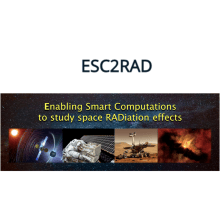
This project aims at establishing a fundamental and applied research program via the set up of a new “virtual modeling lab” which will open the path towards a change of paradigm in the modelling of Space Weather impact.
R-I PEERS- Pilot experiences for improving gender equality in research organisations
 The R&I PEERS project will be based on the concept of gender equality, that can be expressed as “women and men enjoy the same status and have equal opportunity to realize their full human rights and potential to contribute to national, political, economic, social and cultural development, and to benefit from the results”.
Graphene Core 2- Graphene Flagship Core Project 2
 This project is the third stage of the EC-funded part of the Graphene Flagship. It builds upon the results achieved in the ramp-up phase (2013 - 2016) and the first core project (2016 - 2018), and covers the period April 2018 - March 2020.
QuESTech - QUantum Electronics Science and TECHnology training
 QuESTech (Project ID: 766025) is a consortium of 7 leading European research laboratories and 2 high-tech companies. Supported by the European Community, QuESTech will provide a challenging, state-of-the-art training for young researchers in the general field of experimental, applied, and theoretical quantum electronics. The main scientific topics include spintronics, molecular electronics, single electronics, transport in low-dimensional structures, and quantum thermodynamics.
Contacto

Yurdana Castelruiz
Projects Manager
+ 34 943574022
y.castelruiz[at]nanogune.eu